
In a textile mill, cement plant or sugar mill, dozens or hundreds of motors run the process. The MCC panel, short for motor control center, is where those motors are started, stopped, protected and monitored. Choosing the wrong design means longer shutdowns, higher maintenance cost and more risk for your electricians. This guide explains how an MCC panel works, the main types and how to select the right one for your plant.
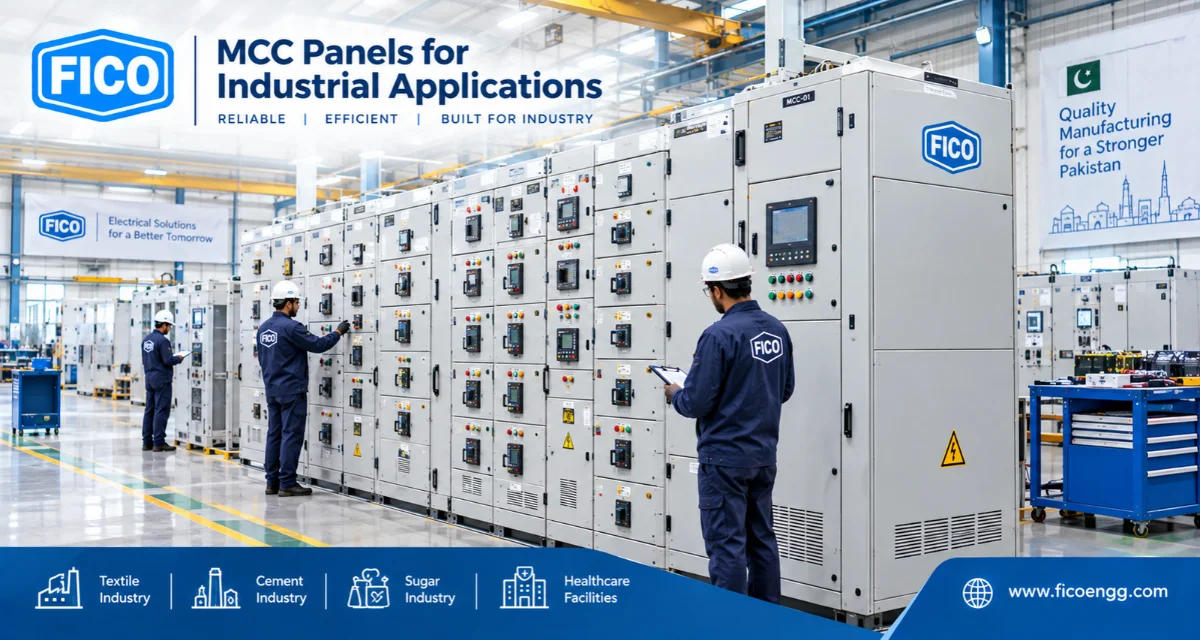
What Is an MCC Panel?
A motor control center (MCC) is a centralized assembly that controls, protects, and monitors multiple electric motors from one location. Instead of installing a separate starter beside every motor an MCC groups the starters into one line-up of cubicles fed from a common busbar system.
Each motor feeder, called a functional unit or bucket, typically provides:
- Short-circuit protection for the motor and its cable
- Overload protection for the motor
- Switching and control, meaning start, stop, and any automatic sequencing
- Isolation, so the feeder can be made safe for maintenance
An MCC is built and verified to IEC 61439-2, and starter components follow the relevant IEC 60947 product standards.
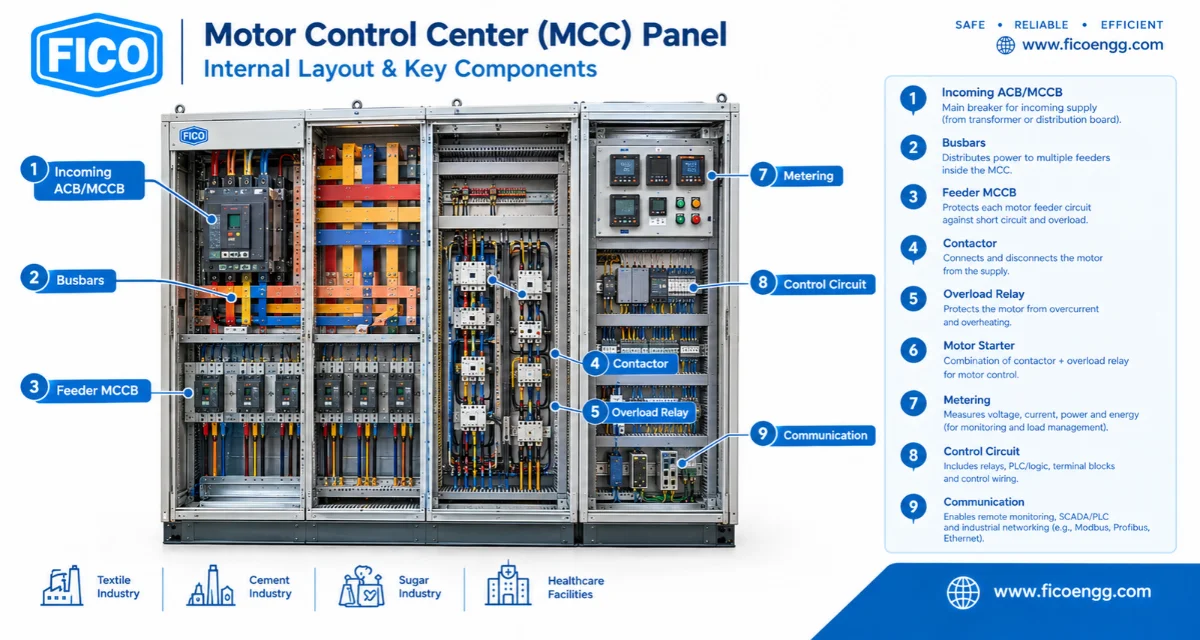
What’s Inside an MCC Panel
| Component | Role |
| Incoming section (ACB or MCCB) | Receives supply and provides main protection and isolation |
| Busbars | Distribute power horizontally and vertically to all feeders |
| Feeder protection (MCCB or fuse-switch) | Protects each motor circuit against short circuits |
| Contactor | Switches the motor on and off |
| Overload relay or motor protection relay | Protects the motor from thermal overload and related faults |
| Starter hardware | Direct-on-line, star-delta, soft starter, or VFD, depending on the motor |
| Control circuit | Control transformer, selector switches, push buttons, indicators |
| Metering and communication (optional) | Current monitoring, PLC or SCADA interface |
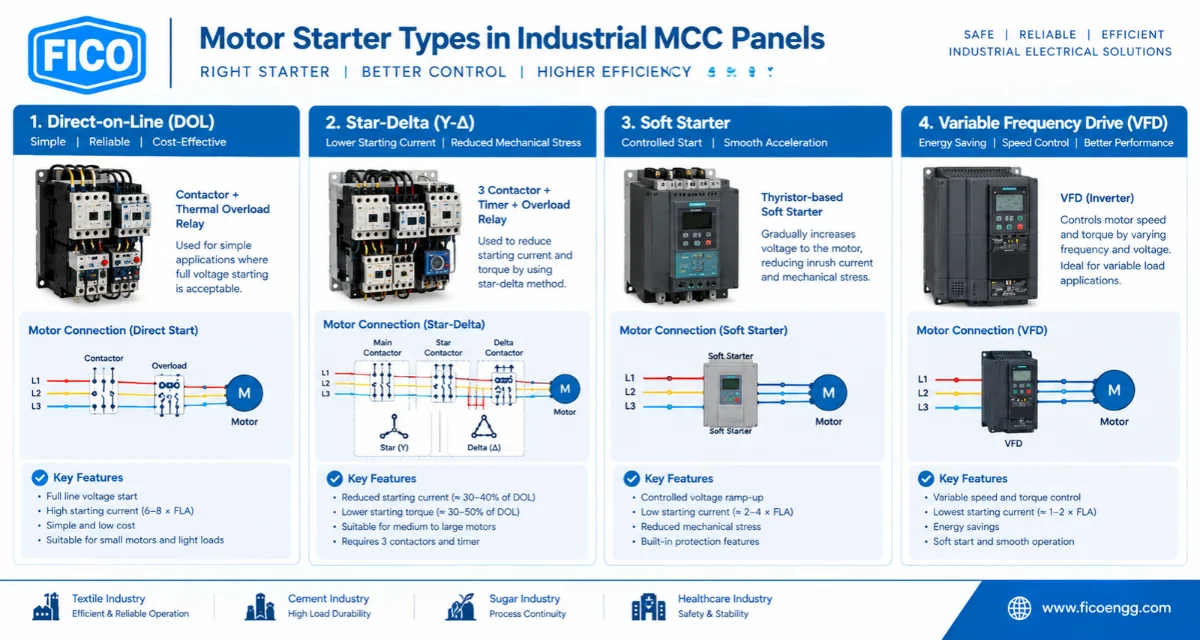
Common Starter Types Used in MCCs
The starter type depends on the motor size and how your process needs it to start.
- Direct-on-line (DOL): simplest and cheapest; connects the motor straight to full voltage. Suitable for smaller motors, but draws high starting current, often around 5 to 7 times rated current.
- Star-delta: reduces starting current and torque by starting in star and running in delta. Common for medium-sized motors that start with light loads.
- Soft starter: ramps up voltage electronically for a smooth, controlled start with lower mechanical and electrical stress.
- Variable frequency drive (VFD): controls both starting and running speed, and can reduce energy use on fans and pumps.
Many industrial MCCs combine several types in one line-up, matched to each motor’s size and duty.
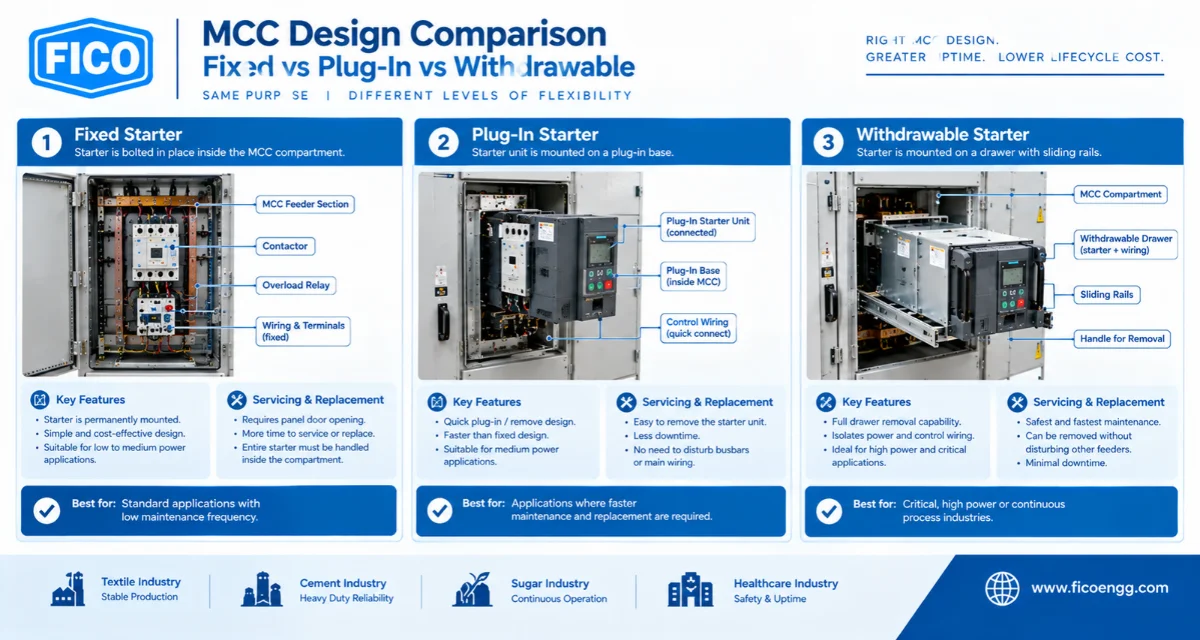
Fixed vs Plug-In vs Withdrawable MCC
The biggest design choice is how each feeder unit is mounted in the cubicle.
Fixed-type MCC Each functional unit is permanently wired and bolted in. It is the simplest and lowest-cost option, but servicing a feeder usually means shutting down that section, or sometimes the whole panel, to work safely. Best for: smaller installations, non-critical loads, tight budgets.
Plug-in MCC Units connect to the busbars through plug-in contacts but are typically isolated before they are removed. This gives faster replacement than fixed designs, with a lower cost than full withdrawable construction. Best for: mid-range installations where faster servicing is useful.
Withdrawable (draw-out) MCC Each starter unit is built on a drawer that slides out of the cubicle on guides. A faulty starter can be racked out and replaced with a spare in minutes, while neighbouring feeders keep running. Best for: continuous-process plants such as cement, textile, and sugar, where a long outage for one failed starter is not acceptable.
| Fixed | Plug-in | Withdrawable | |
| Cost | Lowest | Medium | Highest |
| Servicing speed | Slowest | Faster | Fastest |
| Shutdown needed for service | Often yes | Limited | Usually no |
| Typical form of separation | Lower forms | Medium forms | Higher forms (3b, 4b) |
| Best for | Simple, low-criticality | General industrial | Critical continuous plants |
For more on how internal separation interacts with these designs, see our guide to Form-1 to Form-4b.
Coordination: Why “Type 1” and “Type 2” Matter
Under IEC 60947-4-1, starter coordination describes what happens to the components after a short circuit:
- Type 1: the starter may be damaged after a fault, but must not endanger people or the installation. Parts may need replacement before restarting.
- Type 2: after a fault, the contactor and overload relay remain suitable for further use, apart from light contact welding that is easy to separate.
Type 2 coordination costs more but gets a plant running again sooner, so it is often preferred where downtime is expensive. Ask your supplier which type each feeder is selected for, and request the coordination tables.
How to Select an MCC Panel for Your Plant
- List your motors: kW or HP rating, voltage, duty (continuous or intermittent), and starting method for each.
- Choose starter types based on starting-current limits, process needs, and energy goals.
- Decide on fixed, plug-in, or withdrawable based on how costly it is to lose a feeder.
- Select the form of separation (Form 3b or Form 4b are common for industrial MCCs, per your specification).
- Check ratings: busbar rated current, short-time withstand current (Icw), and IP rating for your environment.
- Plan for expansion: include spare feeder units, since adding units later is cheaper if space is already allowed for.
- Decide on control integration: whether you need PLC, SCADA, or motor-management communication.
- Confirm environment: dust, heat, and humidity levels, which drive enclosure and ventilation choices. Textile and cement plants in particular are dust-heavy environments.
MCC Panels for Textile, Cement and Sugar Mills
- Textile mills: many motors starting in parallel across production lines; panels benefit from clear feeder segregation and fast replacement of failed starters.
- Cement plants: very large, heavily loaded motors running continuously; robust busbar ratings, higher forms of separation, and good dust protection matter.
- Sugar mills: high seasonal load with little tolerance for outages in the crushing season; reliability after months of idle time is as important as performance under load.
See also: MV Switchgear for Textile, Cement and Sugar Mills in Pakistan.
FICO Engineering’s MCC Panels
FICO Engineering designs and manufactures MCC panels in Gujranwala as part of its LV switchgear range, built in accordance with IEC 61439-1 & 2, in modular configurations from 630A to 6300A, with Form-1 to Form-4b options. Our MCCs centralize the control, protection, and monitoring of multiple motors, and are supported by in-house engineering from design through factory acceptance testing and commissioning.
View Our LV Switchgear Panels → | Request an MCC Quote →
Frequently Asked Questions
What does MCC stand for?
MCC stands for motor control center, an assembly that controls and protects multiple motors from one location.
What is the difference between an MCC and a PCC?
A PCC (power control center) distributes power to large loads and feeders. An MCC is specialized for starting, protecting, and monitoring motors.
Is a withdrawable MCC worth the extra cost?
For continuous-process plants, usually yes, because a failed starter can be replaced without shutting down neighbouring feeders. For small, non-critical installations, fixed or plug-in designs may be enough.
What starter should I choose for a large motor?
Large motors are usually started with a soft starter or VFD to limit starting current, though the right choice depends on the load and your utility or supply limits.
What standard applies to MCC panels?
The assembly follows IEC 61439-2, and starter components follow IEC 60947 product standards.
How do I get a quote for an MCC panel?
Send your motor list, voltages, and starting requirements to info@ficoengg.com or +92 321 8645951, or use the contact form.