
When you ask for a quote for an LV switchgear panel, you will often see a line like Form 3b or Form 4b. It looks like a small detail but it affects cost, safety and how much of your plant has to shut down every time someone needs to work inside the panel. This guide explains each form of separation in simple language and how to choose between them.
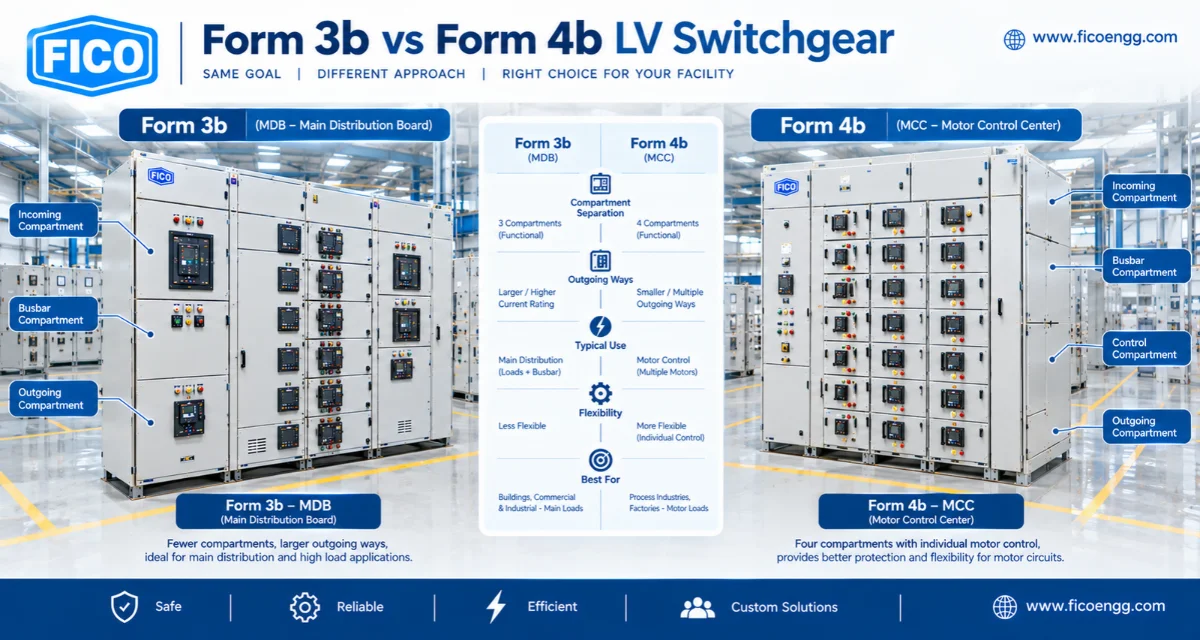
What Is “Form of Separation”?
The form of separation describes how the internal parts of a low voltage assembly are divided from each other using barriers or partitions. The parts in question are:
- Busbars: the main conductors that carry power through the panel
- Functional units: the individual feeders such as a breaker, a motor starter or an outgoing circuit
- Terminals for external conductors: where your cables connect
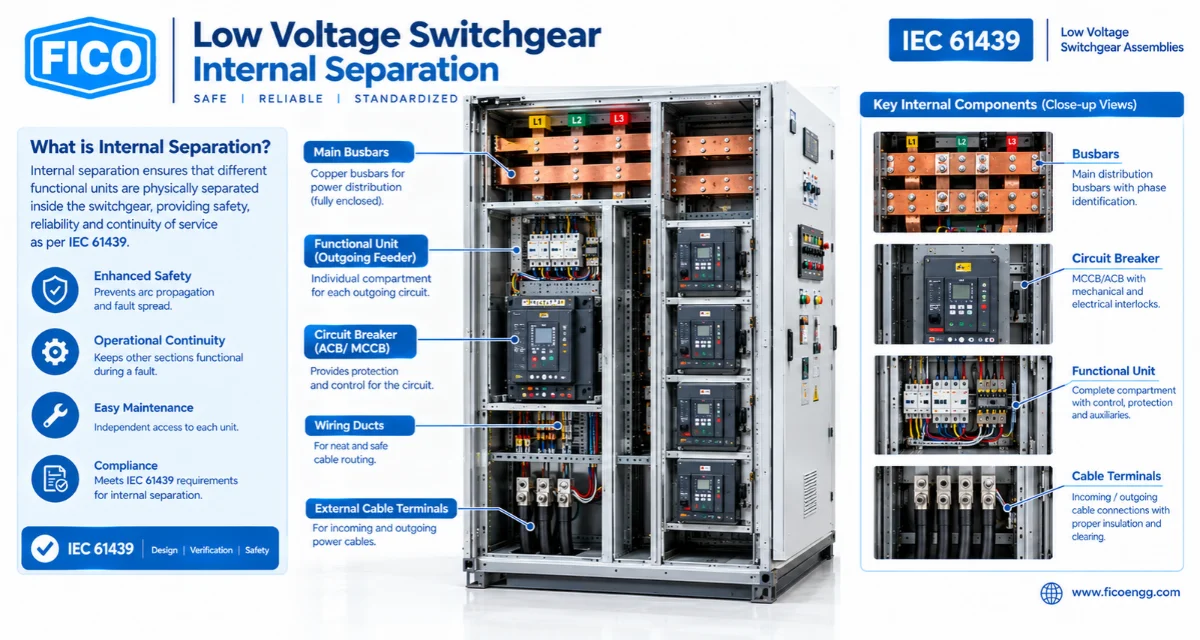
The standard behind it is IEC 61439-2. It defines the forms from Form 1 up to Form 4 with sub variants a and b. More separation means a fault or a maintenance job in one part is less likely to affect another. It also means people working in one section are better protected from live parts in another.
Important: the form describes internal separation only. It is a different characteristic from internal arc withstand, short-circuit rating, and IP rating. A Form 4b panel is not automatically arc-fault rated, so ask for each characteristic separately.
No Internal Separation
In a Form 1 assembly, there is no internal separation between busbars, functional units, and terminals. Everything sits in a common enclosure.
- Cost and size: lowest cost, smallest footprint
- Maintenance: most or all of the panel typically has to be de-energized for work
- Typical use: small distribution boards and simple, low-criticality installations
Form 2: Busbars Separated From Functional Units
In Form 2, the busbars are separated from the functional units. The variants differ in how terminals are handled:
- Form 2a: terminals are not separated from the busbars
- Form 2b: terminals are separated from the busbars
Form 2 improves safety when working on a feeder, since the main busbars are shielded. Functional units are still not separated from each other.
Form 3: Busbars and Functional Units Separated
In Form 3, busbars are separated from the functional units, and each functional unit is also separated from the others. Terminals for external conductors are separated from the functional units, but not from each other.
- Form 3a: terminals are not separated from the busbars
- Form 3b: terminals are separated from the busbars
Form 3b is a common middle ground for industrial panels. A fault or maintenance task in one feeder is isolated from its neighbours, without the added cost of full Form 4 segregation.
Form 4: Maximum Separation, Including Terminals
In Form 4, the busbars, the functional units, and the terminals for external cables are all separated. Each functional unit’s cable terminals are also separated from those of the other units.
- Form 4a: terminals sit in the same compartment as their associated functional unit
- Form 4b: terminals sit in a separate compartment from their associated functional unit
Form 4b switchgear offers the highest level of segregation in the standard. A technician can work on the cable terminals of one feeder, or isolate and service one functional unit, with the least exposure to other live parts and the lowest risk of a fault spreading across the board.
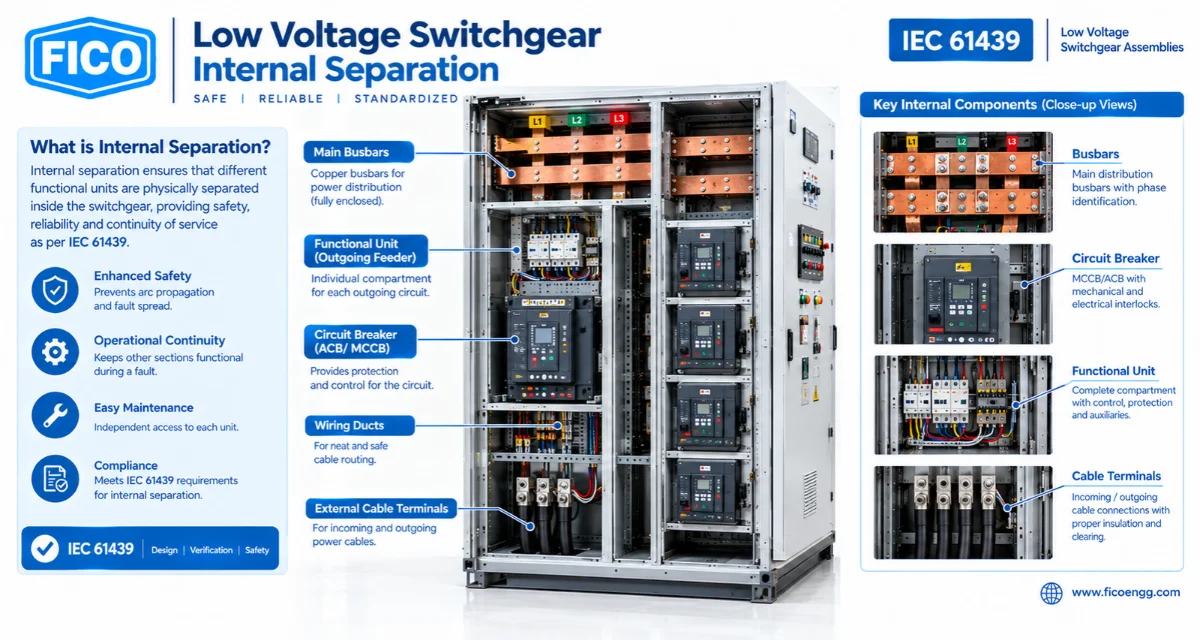
Comparison at a Glance
| Form | Busbars separated from units | Units separated from each other | Terminals separated | Relative cost | Best for |
| Form 1 | No | No | No | Lowest | Small, simple boards |
| Form 2 (2a/2b) | Yes | No | 2b: from busbars | Low | General distribution, limited maintenance needs |
| Form 3 (3a/3b) | Yes | Yes | 3b: from busbars | Medium | Industrial MDBs, PCC and MCC panels |
| Form 4 (4a/4b) | Yes | Yes | Yes (4b: in separate compartment) | Highest | Critical plants, frequent maintenance, high safety priority |
How to Choose the Right Form for Your Facility
Ask these questions:
- What does downtime cost? If shutting a whole line to service one feeder is expensive, higher separation pays for itself. This is the usual case for textile mills, cement plants, and sugar mills.
- How often will the panel be worked on? Panels where feeders are added, changed, or serviced regularly benefit from Form 3b or Form 4b.
- Who will maintain it? Higher separation protects less specialized maintenance staff.
- Is the load critical? Hospitals and process-critical plants usually justify higher forms.
- What does your consultant’s specification say? Many tender documents specify a minimum form. Confirm before you price.
- What are the space and budget limits? Higher forms need more internal space, which affects panel size and cost.
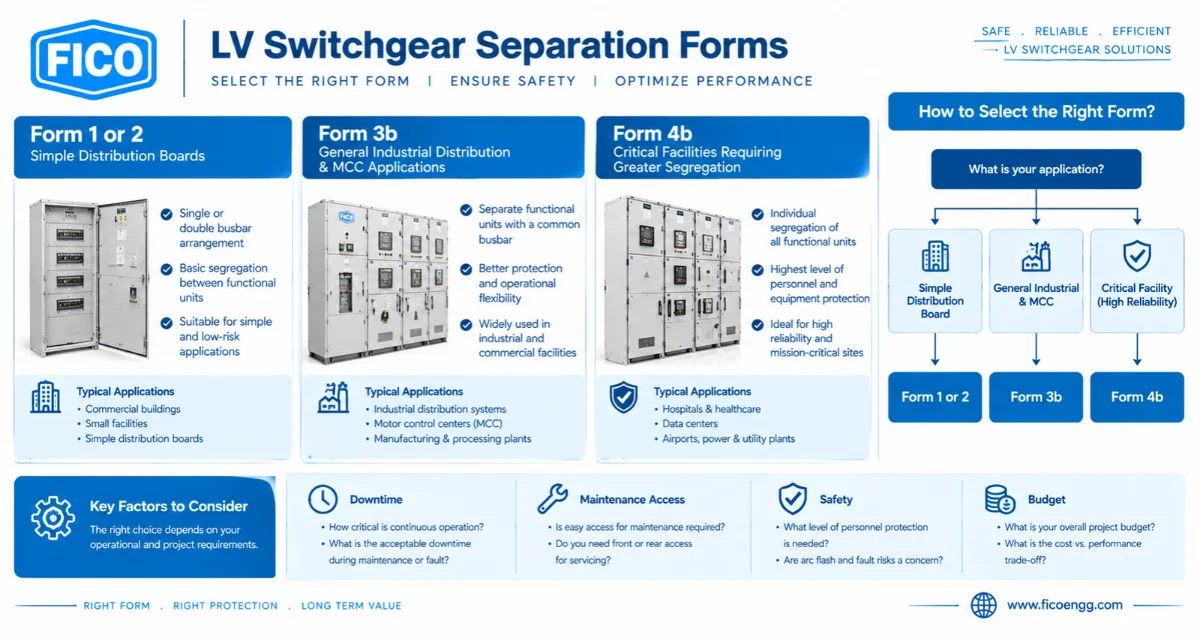
A practical rule of thumb: use Form 1 or 2 for simple, low-criticality boards. Consider Form 3b for most industrial distribution and motor control. Specify Form 4b where continuity of supply and maintenance safety are top priorities. Always confirm against your project specification and your consultant’s requirements.
How the Form Relates to Your Panel Type
- MDB / PCC panels: commonly specified in Form 3b or Form 4b, depending on criticality
- MCC panels: the withdrawable-unit design suits higher forms, since individual starters can be isolated and removed without shutting the whole line-up
- Small DBs and meter boxes: typically simple forms are sufficient
Your engineer or consultant makes the final selection. The form should appear explicitly in your quotation for each section of the panel.
FICO Engineering’s LV Switchgear: Form-1 to Form-4b
FICO Engineering manufactures LV switchgear in Gujranwala across the full range, Form-1 to Form-4b, designed in accordance with IEC 61439-1 & 2, in modular configurations from 630A to 6300A, for indoor and outdoor use. Our engineers help you choose the form that fits your load profile, maintenance plan, and budget, rather than defaulting to the cheapest or the most expensive option.
View Our LV Switchgear Panels → | Request a Quote →
Frequently Asked Questions
What is the difference between Form 3b and Form 4b?
Both separate busbars and functional units. In Form 4b, the terminals for each unit’s external cables are also in a separate compartment from the functional unit itself, giving the highest level of segregation.
Is a higher form always better?
It is safer and more maintainable, but it costs more and needs more space. The right form depends on your downtime cost, maintenance practice, and specification.
Does Form 4b mean the panel is arc-proof?
No. Internal separation and internal arc withstand are different characteristics. Ask for each one separately.
Which form is best for MCC panels?
It depends on criticality, but many industrial MCCs are specified in Form 3b or Form 4b. Follow your consultant’s specification.
Can FICO build to a form specified in my tender?
FICO builds from Form-1 to Form-4b. Send us your specification and we will confirm the configuration in the quotation.