
Power outages caused by a single cable fault are one of the most common and most avoidable reliability problems in distribution networks. A ring main unit is the piece of switchgear built specifically to solve this, and it’s become a standard part of urban, industrial, and utility distribution planning across Pakistan. This guide explains what an RMU is, how it works, and when your facility should be specifying one.
What Is a Ring Main Unit?
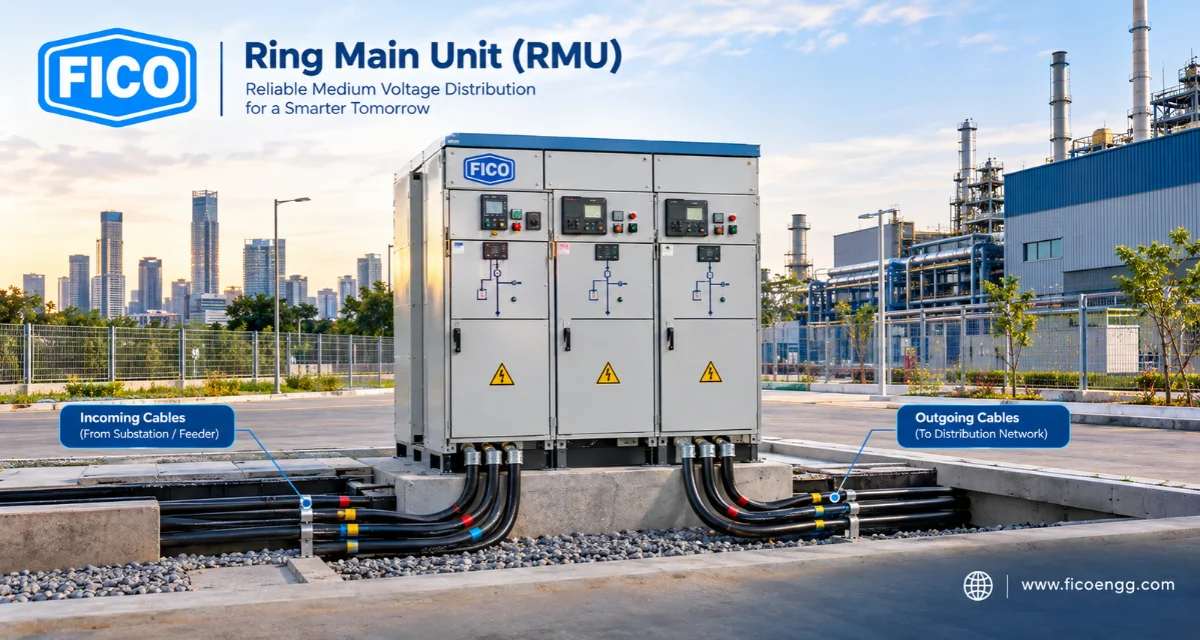
A ring main unit (RMU) is a compact, fully enclosed medium voltage switchgear unit designed for use in a ring network which is a distribution topology where power can reach a given point from two directions instead of one. If a cable fault occurs on one side of the ring, the RMU isolates just the affected section while power continues flowing to the rest of the network from the alternate path.
This is the core advantage of a ring main unit in Pakistan’s growing urban and industrial distribution networks: instead of an entire feeder going down when a single fault occurs, only the faulted section is isolated, and supply continuity is maintained for everyone else on the ring.
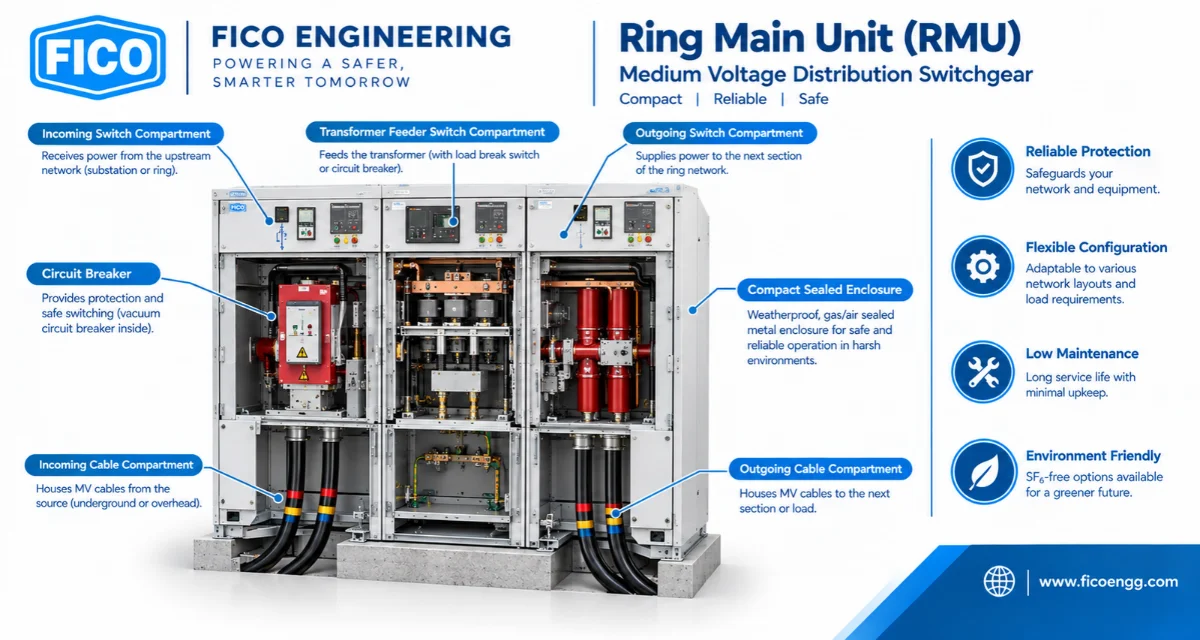
A typical RMU includes:
- Incoming and outgoing switch compartments to connect the ring cables on either side
- A transformer/feeder switch or circuit breaker to protect the connected load
- Compact, sealed construction often gas-insulated like for space-constrained or underground installations
How Ring Main Units Work in a Distribution Network
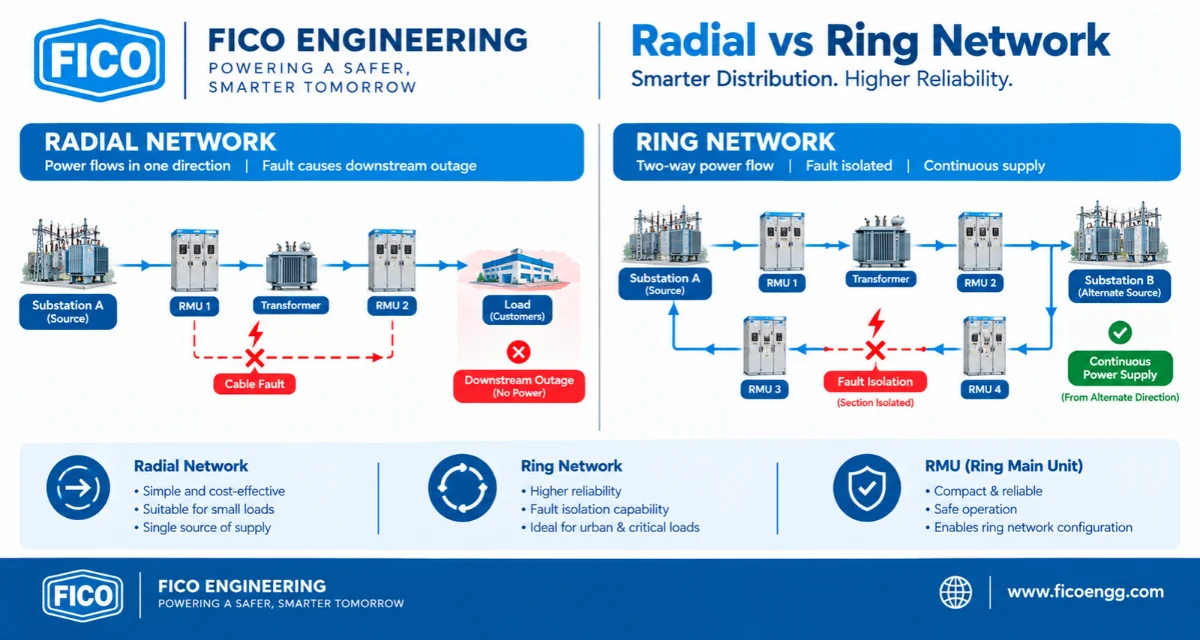
Radial network (without RMU): Power flows in one direction along a single feeder. A fault anywhere on that feeder cuts power to everything downstream of it until the fault is repaired.
Ring network (with RMU): Power can flow from either direction around the ring. When an RMU detects a fault on one side, it isolates that section — power is automatically re-routed from the other direction, and only the faulted segment is affected.
This is why ring main units are the standard choice for any network where continuity of supply matters more than the marginal extra cost of ring topology over radial — which, in Pakistan, increasingly includes urban commercial areas, industrial parks, and utility-fed sites.
When Your Facility Needs a Ring Main Unit
- Urban or semi-urban facilities connected to underground cable networks, where a single feeder fault would otherwise mean an extended outage
- Industrial parks or multi-building sites where one building’s fault shouldn’t take down power to neighboring facilities on the same network
- Facilities with zero tolerance for extended outages like hospitals, data-sensitive operations, or continuous-process industrial sites
- New substation or distribution network design where planning for ring topology from the start avoids costly retrofits later
If your facility currently runs on a single incoming feeder with no alternate supply path, a ring main unit is one of the most cost-effective reliability upgrades available, it doesn’t require duplicating your entire supply infrastructure, just adding the switching capability to use an alternate path when one exists or is planned.
RMU vs Standard MV Switchgear Panel
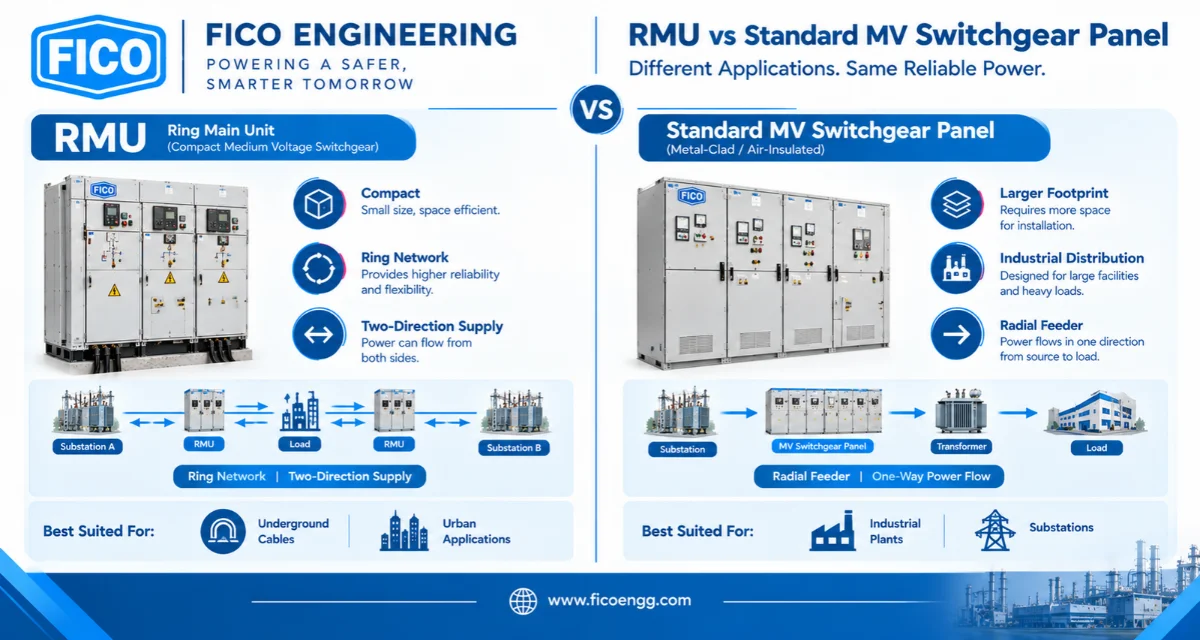
| Ring Main Unit (RMU) | Standard MV Switchgear Panel | |
|---|---|---|
| Network topology | Ring (two-directional supply) | Typically radial (single direction) |
| Footprint | Compact, often gas-insulated | Larger, typically air-insulated |
| Best for | Urban/underground distribution, multi-point networks | Industrial plants, substations with ample space |
| Fault response | Isolates only the faulted ring segment | Isolates the affected feeder/section |
Many industrial facilities in Pakistan such as textile mills, cement plants, sugar mills use standard MV switchgear panels at the plant’s main distribution point, while ring main units are more common at the utility or campus-distribution level, connecting multiple buildings or feeding points within a larger site.
Read more: MV vs LV Switchgear | Which One Does Your Facility Need?
Talk to FICO Engineering
FICO Engineering manufactures ring main units and MV switchgear panels from its Gujranwala facility, backed by in-house engineering services like system design, SLDs, and protection scheme design — so your network topology is planned correctly from the start, not retrofitted after a preventable outage.